Quality
OEKO-TEX Certification for Textile Components
The certificate is valid when its range corresponds to the material, colour and application of a particular product.
What the document confirms and what should not be said
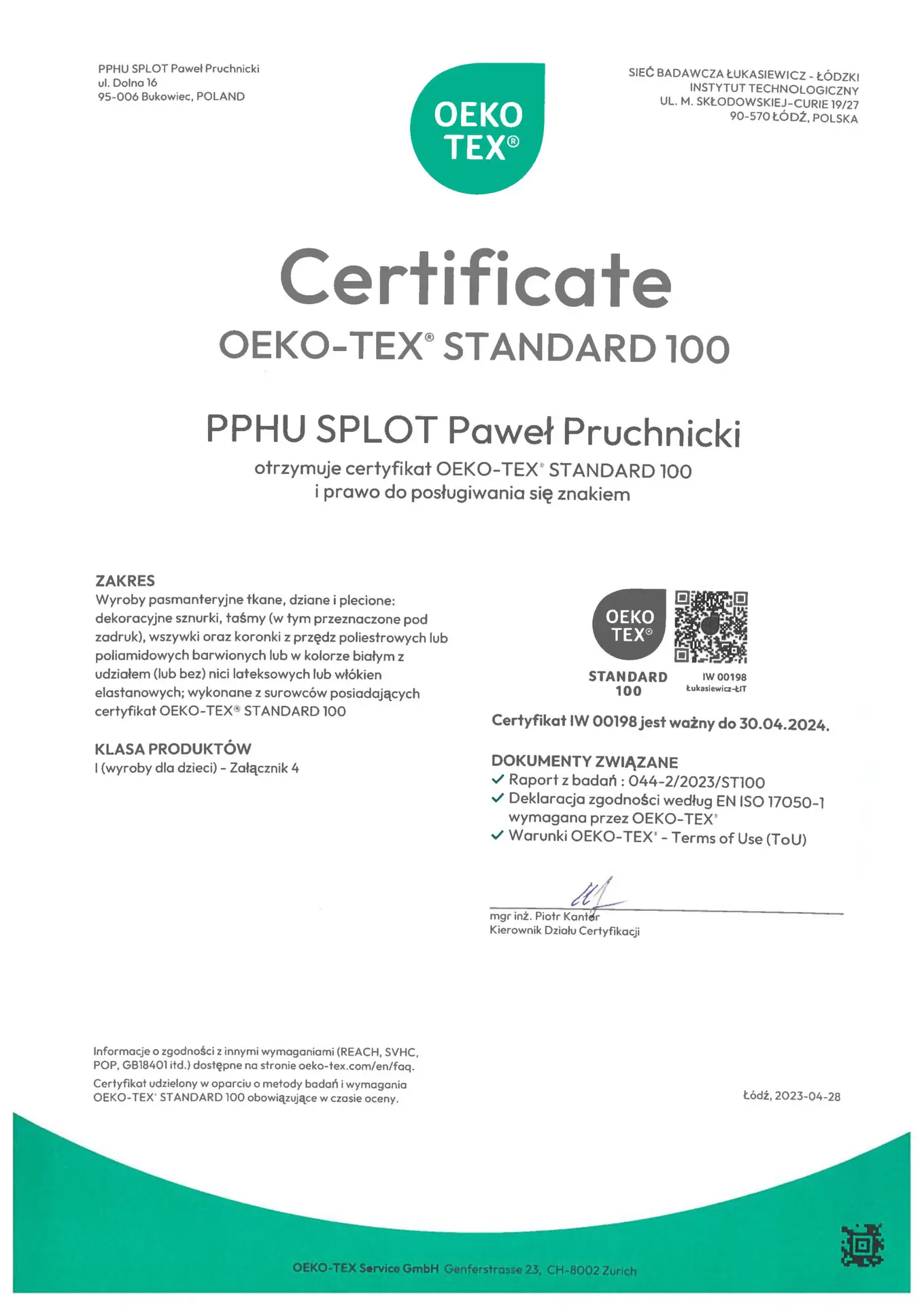
When purchasing a component, the password “OEKO-TEX” is not enough. You must check the owner of the document, the number, the expiry date, the product class and the exact range of products. The certificate for raw material or specific material group should not be automatically extended to any variant of the finished product.
The export of SPLOT-PAS describes two ranges: woven, knitted and plaited products of white polyester yarns and analogous products of white polyester yarns from recycled PET, both with or without latex threads and of raw materials having STANDARD 100 by OEKO-TEX. Before ordering, check the current document and compliance of the selected variant with its scope.
Scope must fit the order
Color, composition, additional finishing, printing or glue may change the product under review. Therefore, in the briefing it is worth separating the requirements for yarn, semi-manufactured and finished components. If the product is placed in children's clothing, medical clothing or in constant contact with skin, the recipient should clearly specify the required level of documentation.
Ask for a document in the version applicable for the production date and keep it with the batch number or order order. This facilitates the audit and subsequent reproduction of the marketing declaration basis.
Recyclable materials
The recycling declaration should indicate the source and share of the material and the document on which it is based. In the case of the export description, polyester yarn made from usable PET bottles is mentioned. This does not automatically mean that each element of each textile webbing is secondary origin.
Precise wording protects the brand from greenwashing. The message to the customer should correspond to the actual scope of the product ordered, not the most general name of the certificate.
Documentary Checklist
Before the material is approved, combine the documentation with a physical sample and specification. The certificate does not replace the functional test of the finished product.
- Document number, issuer and expiry date
- Certificate holder and place of production falling within the scope
- Type of product, composition, colour and class of use
- Additives: latex, printing, glue, metal or plastic elements
- Linking the document to the order and version of the sample
Frequently asked questions
Does the raw material certificate automatically include the finished product?
This should not be assumed. You should compare the scope of the document with the full composition and method of finishing a particular product.
How do I check the validity of the document?
Verify the number, owner, scope and expiry date in the material provided by the supplier, and when possible also in the exhibition database.
Does the certificate replace the utility test?
No. Material documentation and functional test answer different questions; both elements may be needed in component qualification.